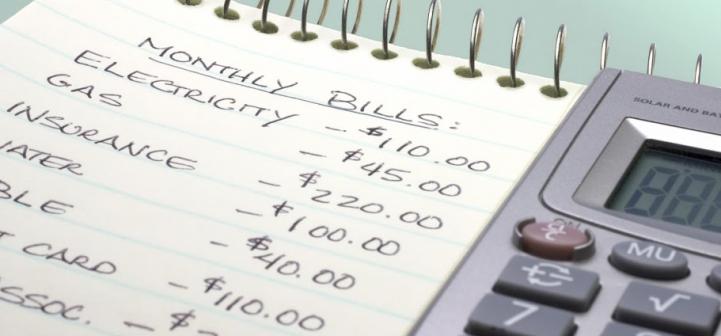
Life’s emergency situations require advance preparation and planning. The first step is organizing your financial information. Do you have an appropriate place for filing each document? Have you told anyone else where you keep your vital information? Have you shared your wishes in the event of your death? Are your documents available to “grab and go” in case of evacuation? Many situations require that you take action now to avoid financial problems later.
The High Cost of Credit Card Minimum Payments
The High Cost of Credit Card Minimum Payments
Barbara O’Neill, Ph.D., CFP®, Rutgers Cooperative Extension, oneill@aesop.rutgers.edu
When it comes to managing your money, compound interest can be your friend (e.g., through systematic long-term investing) or your enemy (e.g., by making minimum payments on outstanding debt). This article will focus on the latter; specifically, the high cost of credit card minimum payments. Of all the credit card traps that are out there, and there are quite a few (e.g., late fees, …
A Comparison of Mutual Funds and Exchange Traded Funds (ETFs): Twelve Factors to Consider
Prepared by Dr. Jason L. Johnson, Associate Professor, Extension Economist, Registered Investment Advisor Texas A&M University and Texas AgriLife Extension.
Since the early 1990s, investors have had a choice between traditional mutual funds and a more recent counterpart labeled exchange traded funds (ETFs). Mutual fund assets continue to dominate the financial market with over $12.3 trillion invested. Between 2002 and the end of 2007, assets in ETFs increased almost 500% to more than $608 billion. On the surface, these two …
How to Select a Credit Card
Barbara O’Neill, Ph.D., CFP®, Rutgers Cooperative Extension, oneill@aesop.rutgers.edu
The best way to select a credit card is to match it to your intended use and bill-paying habits. Are you a “revolver?” Revolvers are credit card users who rarely, if ever, pay their credit card bills in full and, thus, pay finance charges each month to carry outstanding debt. If you plan to carry a balance from month to month, select a credit card with a permanently low-interest rate; i.e., not …
Investing Unit 3: Finding Money to Invest

|
How to Get Out of Debt and Repair Your Credit
Barbara O’Neill, Ph.D., CFP®, Rutgers Cooperative Extension, oneill@aesop.rutgers.edu
Got outstanding loan balances and credit card debt? Do monthly payments seem overwhelming? You are not alone. The ability to “buy now and pay later,” coupled with slick advertising, has made living beyond one’s means very tempting. As a result, many Americans, at all income levels, went on a credit-fueled “spending spree” during the late 1990s and early 2000s. Now it’s time to pay back what we owe and get out of …
Financial Security for All Research
Family Economics Research
Family economics research focuses on how individuals and families obtain and use resources of money, time, human capital, material resources, and community services. The research also explores the relationship between individuals and families and the larger economy and studies the impact of public issues, policies, and programs on family economic well-being.
This area provides research summaries of current research in family economics (with links to the complete article, if available).
Research Summaries Currently Available by Topic:
Credit
…How Much Consumer Debt is Too Much?
Barbara O’Neill, Ph.D., CFP®, Rutgers Cooperative Extension, oneill@aesop.rutgers.edu
The term “consumer debt” refers to all types of non-mortgage debt obligations. Examples include outstanding balances on credit cards, installment loans for cars and other “big ticket” items (e.g., furniture and appliances), and student loans. For every person with outstanding consumer debt, there comes a point, called “enough,” where carrying too much debt starts to cause financial stress. Even minimum required payments become difficult to make or perhaps some payments get skipped …
Managing Money in Tough Times: Taking Charge in Challenging Times
Dealing With Collection Agencies
Barbara O’Neill, Ph.D., CFP®, Rutgers Cooperative Extension, oneill@aesop.rutgers.edu
Outstanding credit accounts often go to collection agencies when people fail to pay their creditors. One of the most stressful parts of being in debt is receiving phone calls and letters from collection agencies requesting immediate repayment of outstanding balances. It is typical for calls and letters to become more aggressive and threatening over time. The term “collection agency” describes a variety of business models that have one thing in common: recovering …